
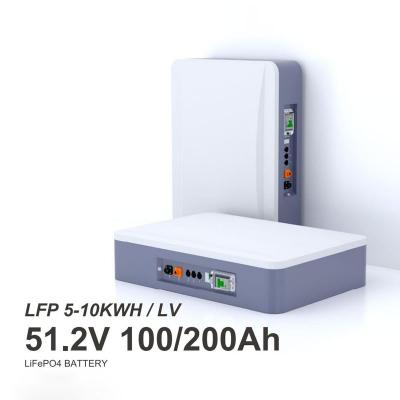
Solar Energy Storage Battery Market Surges: From Grid Backup to Grid Foundation
2024-02-23
Market Overview
The global solar energy storage battery market is experiencing explosive growth as storage shifts from a "nice-to-have" add-on to an essential component of modern solar installations. According to industry research, the market was valued at US$ 6.03 billion in 2025 and is projected to reach US$ 17.49 billion by 2032, growing at a CAGR of 16.5% . More broadly, the total solar energy storage market (including systems and services) reached US$ 70.09 billion in 2025 and is expected to hit US$ 80.72 billion in 2026, with a 15.2% CAGR .
The industry added a record 57 GWh of new storage capacity in the U.S. alone in 2025, enough to power 5.1 million homes, according to the Solar Energy Industries Association (SEIA) . This record is expected to be eclipsed again by the end of 2026, with projected additions of 70 GWh .
Why Storage Matters in 2026
| Driver | Impact |
|---|---|
| Tariff Volatility | Dynamic pricing and negative tariffs in Europe and other regions make storage critical for revenue protection |
| Grid Congestion | Stand-alone solar increasingly struggles with grid capacity limits, forcing hybridization with storage |
| Energy Independence | Homeowners and businesses prioritize backup power and bill management |
| AI Data Center Demand | Commercial and industrial storage installations jumped 42% in 2025, largely driven by data center power needs |
| NEM 3.0 Policy | California's new net metering framework pushes developers toward maximized self-consumption strategies |
Key Market Statistics
| Metric | Value |
|---|---|
| Global Market Value (2025) | US$ 6.03 billion (batteries only) / US$ 70.09 billion (total market) |
| Projected Market Value (2032) | US$ 17.49 billion |
| CAGR (2026-2032) | 16.5% |
| U.S. Storage Added (2025) | 57 GWh |
| Residential Growth (2025) | >50% year-over-year |
| C&I Growth (2025) | 42% year-over-year |
| Average Battery Price (2025) | US$ 230 per kWh |
| Industry Capacity Utilization | ~61% |
| Average Gross Margin | ~30% |
Technology Trends
1. Sodium-Ion Batteries Enter the Market
Moonwatt, a Dutch startup founded in 2024, is deploying a new class of sodium-ion battery energy storage system specifically developed for hybrid solar plants . The technology uses sodium-ion NFPP chemistry, which offers:
Superior thermal stability and safety compared to lithium-ion
Excellent degradation performance under both low and high temperatures
Passive cooling with no moving parts, reducing O&M costs
Distributed "string battery" architecture that scales from kilowatts to gigawatts
The system is DC-coupled to solar panels via a shared hybrid inverter, removing the need for additional medium-voltage transformers. Moonwatt has secured a €1.15 million grant from the Dutch Business Agency (RVO) and will deploy its first project in 2026 at Cleantech Park Arnhem, Netherlands .
2. Liquid Cooling Becomes Mainstream
Traditional air cooling is being replaced by liquid cooling for high-power, high-energy-density storage systems. Liquid cooling offers higher heat dissipation efficiency, better temperature uniformity (cell temperature variance ≤3°C), and extended cycle life (up to 12,000+ cycles) . This is particularly critical for utility-scale and commercial applications where system longevity directly impacts return on investment.
3. AC vs. DC Coupling
The market offers two primary coupling architectures:
| Architecture | How It Works | Best For |
|---|---|---|
| DC-Coupled | Batteries share the same inverter as solar panels; stored energy stays in DC until conversion to AC | New installations, higher round-trip efficiency (94-98%), lower cost |
| AC-Coupled | Batteries have their own dedicated inverter; stored energy goes DC→AC→DC→AC | Retrofits, existing solar systems, applications requiring battery backup independent of solar |
Moonwatt's DC-coupled approach eliminates an additional MV transformer, reducing balance-of-plant costs and increasing efficiency by avoiding unnecessary AC/DC conversions .
4. Grid-Forming Technology
Inverters that provide voltage and frequency stability are becoming a standard requirement rather than an optional feature . This shift enables batteries to actively support grid stability, not just passively store energy.
5. Non-Lithium Scaling
Sodium-ion and flow batteries are gaining "bankability" in Europe and the UK as long-duration storage needs grow . This diversification reduces reliance on lithium supply chains and opens new cost and safety advantages.
Integrated C&I Solutions: SolarEdge + Socomec
In February 2026, SolarEdge announced a new integrated PV-plus-storage offering for the commercial and industrial segment in the U.S. and Canada . The solution combines:
SolarEdge's C&I PV inverters and power optimizers (designed to meet FEOC and Domestic Content requirements)
SolarEdge ONE for C&I Energy Management System (EMS)
Socomec storage systems (SUNSYS HES L Skid: 50-300 kVA power range, 204-612 kWh capacity)
Key features:
Single unified platform combining PV, storage, and EMS
Reduces traditional three-vendor integration (separate PV, storage, EMS providers) to a simplified two-vendor system
Capabilities include: Maximized Self-Consumption (MSC), peak shaving, Time-of-Use (ToU) scheduling with non-export and power-export control
Retrofit-ready: Existing SolarEdge C&I installations can add storage without PV system redesign
Marty Rogers, GM of North America at SolarEdge, noted: "C&I developers have long struggled with the traditional three-vendor model... We're solving this with a truly integrated solution that reduces system complexity and increases reliability for commissioning and ongoing operations" .
Regional Market Dynamics
United States
The U.S. storage market underwent a massive structural shift in 2025, moving from a niche reliability tool to an indispensable asset . Key trends:
Residential resilience: Home battery capacity grew by more than 50% in 2025 as homeowners prioritized backup power and bill management. SEIA expects this market to expand by another 120% by 2030 .
Data center demand: Commercial and industrial storage installations jumped 42% last year, largely responding to data center needs. As gas turbine shortages delay traditional generation, developers are increasingly pairing storage with solar .
Bipartisan deployment: Two-thirds of all new storage capacity in 2025 was built in states won by President Trump, demonstrating storage as a bipartisan infrastructure win .
Australia
Australia leads the world in rooftop solar penetration, with millions of homes adopting solar PV systems . The government has expanded the Cheaper Home Batteries Program with up to A$7.2 billion in funding over four years through 2030 .
Key policy changes effective May 1, 2026:
Tiered STC structure: 0-14 kWh (100% factor), 14-28 kWh (~60% factor), 28-50 kWh (~15% factor)
STC factor reductions twice yearly to align with falling battery costs
A typical 10 kWh battery system costs approximately A$11,120 before rebate, with net cost after rebate around A$7,000-8,500 .
India
The Indian battery energy storage system market is rising rapidly due to falling solar costs and growing renewable energy targets . Price ranges:
| Scale | Capacity | Price Range (₹) | Price per kWh (approx.) |
|---|---|---|---|
| Home/Small Commercial | 5-20 kWh | ₹3-10 lakh | ₹60,000-75,000 |
| Commercial/Industrial | 50 kWh - 5 MWh | ₹50 lakh - 5 crore+ | ₹40,000-60,000 |
Lithium-ion batteries (8-15 year lifespan) are preferred over lead-acid (3-5 years) despite higher upfront costs, due to better lifecycle economics .
System Sizing and Costs
Residential Systems
| Battery Size | Typical Application | Pre-Rebate Cost (AUD) | Net Cost After Rebate |
|---|---|---|---|
| 5-10 kWh | Small home, essential loads | ~$8,000-12,000 | ~$5,000-8,500 |
| 10-15 kWh | Average home, most loads | ~$12,000-16,000 | ~$8,500-12,000 |
| 15-20 kWh | Large home, whole-home backup | ~$16,000-22,000 | ~$12,000-16,000 |
Commercial Systems
| System Size | Typical Application | Cost Range (USD) | Payback Period |
|---|---|---|---|
| 50-250 kW | Small business, retail | $50,000-250,000 | 5-7 years |
| 250 kW - 1 MW | Mid-size commercial, manufacturing | $250,000-1,000,000 | 4-6 years |
| 1-10 MW | Large industrial, utility | $1M-10M | 3-5 years |
Return on Investment Example
Residential (Australia)
| Parameter | Value |
|---|---|
| System Capacity | 10 kWh |
| System Cost (after rebate) | A$8,000 |
| Daily Stored Solar | 15 kWh |
| Energy Tariff | A$0.30/kWh |
| Annual Savings | 15 × 365 × 0.30 = A$1,642.50 |
| Payback Period | ~4.9 years |
Commercial (U.S.)
| Parameter | Value |
|---|---|
| System Capacity | 500 kWh / 250 kW |
| System Cost (after ITC) | $350,000 |
| Peak Shaving Savings | $25,000/year |
| ToU Arbitrage | $15,000/year |
| Demand Charge Reduction | $10,000/year |
| Total Annual Savings | $50,000/year |
| Payback Period | ~7 years |
Future Outlook (2026-2030)
The solar energy storage market is expected to continue rapid growth, reaching US$ 140.45 billion by 2030 at a 14.9% CAGR . Key trends shaping the industry:
Supply chain diversification: Developers are diversifying beyond China to meet FEOC requirements; system prices expected to stabilize by H2 2026
Grid-forming inverters: Becoming standard requirement rather than optional feature
Non-lithium scaling: Sodium-ion and flow batteries gaining bankability for long-duration applications
AI-driven energy management: Smart EMS platforms automatically optimize dynamic tariff savings and battery ROI
Virtual Power Plants (VPPs): Aggregated residential batteries providing grid services
Data center co-location: Storage paired with solar to manage massive AI training loads that jump to 90% capacity in milliseconds
In a Nutshell
Solar energy storage batteries are no longer an afterthought—they are the key that unlocks the full potential of solar power. From sodium-ion breakthroughs and integrated C&I solutions to residential systems saving thousands on electricity bills, storage is transforming solar from an intermittent power source into a reliable, dispatchable, and increasingly intelligent energy asset. With costs falling, policies supporting adoption, and technology advancing rapidly, 2026 marks the year storage moves from grid backup to grid foundation.
Related Blog
Plug-and-Play Solar Mounting: A Smarter Way to Use Limited Space
Solar panel corrugated roof mounting brackets help create a secure connection between solar modules and building surfaces, but installation can become difficult when space and construction conditions are limited
2026-09-11
Quick-Install Solar Mounting: Making Balcony Power Projects Simpler
Reliable roof mounting systems for solar panels can help installers create stable and organized module layouts while making better use of available building space
2026-09-08
In Roof Solar Panel Mounting Made Easy for Smarter Home Energy
In roof solar panel roof mounting systems can provide a clean way to integrate solar modules with building structures while making efficient use of available space
2026-09-05