
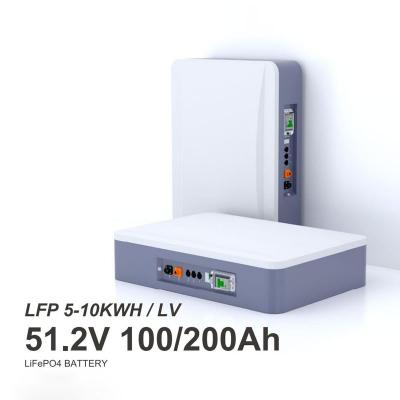
The Year of the Global Home Energy Storage Boom – The 5kWh Off-Grid Hybrid LiFePO₄ Battery Becomes the “Standard” for Household Energy Independence
2022-01-12
Market Explosion: Global Home Energy Storage Installations Surge Over 130% Year-on-Year in 2022
The global residential energy storage market reached a critical inflection point in 2022. Data shows that new installations of household energy storage systems worldwide reached 15.6 GWh in 2022, a year-on-year increase of 136.4%. Against the backdrop of rising energy costs in Europe and heightened energy supply tensions following the Russia-Ukraine conflict, residential electricity costs continued to climb, and power supply stability became an urgent concern. As a result, residential solar-plus-storage systems are increasingly seen as a necessity. It is projected that by 2025, global new household energy storage installations will reach 52.6 GWh, and by 2030, this figure could further rise to 172.7 GWh.
Amid this market boom, the 5kWh storage unit demonstrated unique advantages – its capacity can meet the basic overnight electricity needs of an average household while serving as a modular building block that can be paralleled to scale from 5kWh to 30kWh or even higher, balancing affordability with expandability.
Technology Path: LiFePO₄ Becomes the Absolute Mainstream for Off-Grid Storage
In the 2022 storage market, lithium iron phosphate (LiFePO₄) batteries dominated the off-grid and hybrid storage technology landscape due to their high safety, long cycle life, and cost advantages. Compared to NMC (nickel-manganese-cobalt) batteries, LiFePO₄ contains no scarce metals such as cobalt or nickel, offers better high-temperature tolerance and thermal stability, and provides outstanding safety for residential storage applications.
Taking the mainstream 5kWh off-grid hybrid storage battery in 2022 as an example, key technical parameters had matured: nominal voltage of 48V to 51.2V, rated capacity of approximately 100Ah, and cycle life typically exceeding 5,000 to 6,000 cycles, with some products reaching up to 8,000 cycles. Equipped with an intelligent Battery Management System (BMS) that monitors cell voltage, current, and temperature in real time, these batteries prevent overcharge, over-discharge, and short circuits, ensuring long-term safe and stable operation.
In terms of product form, the 2022 market featured both split-type and all-in-one configurations. Split-type systems consist of separate battery modules and inverters, offering flexible configuration and easy expansion. All-in-one products integrate the battery, inverter, and control system into a compact unit, simplifying installation – especially advantageous in high-labor-cost markets, where total cost of ownership is more favorable.
Policy Support: Subsidies and Tax Credits in Multiple Countries Enhance Economics of Residential Storage
Supportive policies for residential energy storage continued to strengthen globally in 2022, greatly improving the economics of installing home storage systems.
In Europe, Germany offered subsidies of up to €300 per kWh of storage capacity (capped at €15,000) and upgraded its program in September 2022 to “Solar PLUS,” expanding support to building-integrated photovoltaics and facade PV. Italy significantly increased its tax credit for home storage equipment from 50%-65% to 110%. Switzerland, Belgium, and other countries also provided financial support through solar subsidy programs and storage system grants.
In the United States, the Inflation Reduction Act (IRA), passed in August 2022, extended the Investment Tax Credit (ITC) for solar and storage for ten years and increased the credit from 26% to 30%, greatly boosting market expectations for residential storage.
Thanks to these policy benefits combined with high electricity prices, taking Europe as an example, a residential solar-plus-storage system with a 5kW hybrid inverter and 10kWh of storage could achieve a payback period of as little as 2–3 years after subsidies – making the economics highly attractive.
Brand Competition: Domestic and International Players Accelerate Deployment, Market Enters “Red Ocean”
The competitive landscape of the global residential storage market intensified further in 2022. Tesla held approximately 15% of the global market with its Powerwall product, closely followed by China’s Pylontech with about 13%. In addition, Sonnen, BYD, LG Energy Solution, Huawei, GoodWe, and others accelerated their deployment, turning the global residential storage market into a “red ocean”.
In the 5kWh off-grid hybrid storage battery segment, several representative products were launched in 2022. Growatt introduced the AXE LV battery system, covering capacities from 5kWh to 400kWh. Each 5kWh module measured 650×350×165 mm, weighed about 40 kg, and supported 5,000 charge/discharge cycles with a lifespan exceeding 10 years. Huawei launched the LUNA2000-5-E1 module, expandable from 5kWh to 21kWh system capacity, featuring an IP66 protection rating for both indoor and outdoor installation. Chinese company Coremax released a 5kWh–20kWh all-in-one residential hybrid storage system in November 2022, with a round-trip efficiency of 93.93% and a 10-year warranty.
Related Blog
Plug-and-Play Solar Mounting: A Smarter Way to Use Limited Space
Solar panel corrugated roof mounting brackets help create a secure connection between solar modules and building surfaces, but installation can become difficult when space and construction conditions are limited
2026-09-11
Quick-Install Solar Mounting: Making Balcony Power Projects Simpler
Reliable roof mounting systems for solar panels can help installers create stable and organized module layouts while making better use of available building space
2026-09-08
In Roof Solar Panel Mounting Made Easy for Smarter Home Energy
In roof solar panel roof mounting systems can provide a clean way to integrate solar modules with building structures while making efficient use of available space
2026-09-05